Calculation of the required wildlife warning devices
Formula
Number of wildlife warning devices =
(Route in meters × number of road sides × safety margin) ÷ distance between road posts
2000 m route × 2 road sides × 1.2 safety margin ÷ 50 m post spacing = 96 wildlife warning devices
Straight roads (wildlife warning devices without radio signal are required)
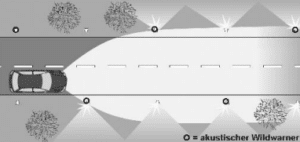

On straight roads, vehicle headlights can illuminate a long distance. The acoustic-optical wildlife warning devices are installed alternately on both sides of the road so that wildlife is warned at an early stage.
On long straight roads and at higher average speeds, sufficient early warning time should be taken into account. A reaction time of about 4 seconds is generally assumed for wildlife.
Recommended spacing of wildlife warning devices:
30 to 50 meters
Road sections with curves (wildlife warning devices with radio signal are required)

In curves, vehicle headlights cannot illuminate as long a distance as on straight roads.
Hill crests, embankments, and road cuttings

On hill crests, embankments, and in valleys or road cuttings, lighting conditions are limited. As a result, only part of the road is illuminated by vehicle headlights.
For this reason, the acoustic-optical wildlife warning devices must also be installed at shorter intervals in these areas to ensure timely warning effectiveness.
Recommended spacing of wildlife warning devices:
30 to 40 meters
Installation notes / Mounting instructions
The wildlife warning devices should be securely attached to the guide posts and aligned in the direction of travel. A clear view of the roadway must be ensured. Plants, branches, or other obstacles must not impair the function of the devices.
Maintenance and inspection
The wildlife warning devices should be checked regularly. This includes checking for dirt, damage, and verifying the function of both the optical and acoustic signals. Damaged devices should be replaced immediately.
The installation of the warning devices has significantly reduced the number of accidents in recent years.